Target Holiday 2025
Interactive Display Campaign | Motion Design & Development
Overview
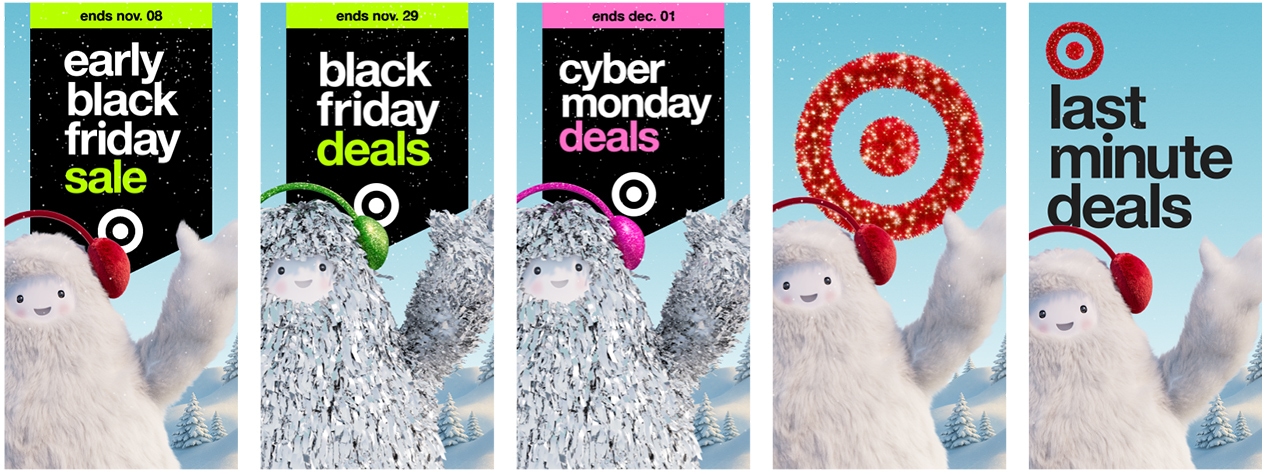
Led motion design and interactive development for Target’s 2025 holiday campaign, delivering a suite of dynamic display units built for scale and performance. The work balanced promotional urgency with intuitive, interaction-driven UX.
Spanning weekly drops from early Black Friday through late December, the system supported rapid iteration across formats, languages, and product variations while maintaining consistency in motion and behavior.
The Challenge
The campaign required a system to support rapid weekly updates tied to evolving promotions, maintain consistency across dozens of dynamic versions, and drive engagement within constrained banner environments—while performing reliably across mobile and desktop.
Modular Motion System
Developed a modular motion system designed to scale across promotional themes, product variations, and English and Spanish versions. This enabled rapid iteration without rebuilding core animation logic.
Shifted the experience toward interaction-driven design, using early engagement triggers, layered product exploration, and a clear motion hierarchy to guide attention and encourage deeper interaction.
Optimized for performance through mobile-first interaction patterns, streamlined animation for speed and responsiveness, and layouts structured to maximize product-level engagement.
Campaign Performance
• 397M+ impressions
• 0.71% CTR
• 2.17% engagement rate
• 3.60% event rate
Mobile units significantly outperformed benchmarks, while desktop units exceeded interactive DCO benchmarks by 8.5x.
Top Performing Creative
Top-performing variants consistently prioritized clarity, hierarchy, and immediate access to product interactions.
Best-performing unit: “Holiday Low Price Meal”
• 40.1M impressions
• 0.88% CTR
• 2.80% engagement rate
• 4.58% event rate
Other high performers, including Last Minute Deals and Top Gifting Deals, reinforced that clarity, urgency, and accessible interaction drive results.
Format Performance
• 300x250 → strongest engagement driver
• 320x50 → highest reach (174M+ impressions)
• Other formats (728x90, 970x250) had minimal performance impact (<1%)
The 300x250 unit generated over 220x more events than the lowest-performing format, underscoring the importance of designing for high-impact placements.
Takeaways
Modular systems are critical for scaling fast-moving campaigns without sacrificing consistency. Interaction design drives performance, with placement hierarchy directly impacting engagement. Format-specific design is especially effective in high-impact units like 300x250, where engagement is concentrated. Localization requires more than translation, demanding thoughtful adaptation to user behavior.